Complete Guide to Buying Property in Baner
Quick links
If you want to buy property in Baner, Pune, this guide walks you through everything that matters—from micro-locations and Baner property prices to legal due diligence, home loans, and builder evaluation. Use our Baner property listings, Baner price trends, and expert consultation as you plan your purchase.
1. Understanding Baner's Real Estate Evolution
(History, Growth & Market Maturity)
When evaluating whether a locality is investment-grade or speculative, history matters more than hype. Baner stands out because its growth has been structural, demand-driven, and resilient—not artificial or bubble-led.
This section explains why Baner became premium, how its real estate matured, and why it avoided sharp crashes when other micro-markets failed.
1.1 Baner's Origins: From Peripheral Village to Strategic Suburb
Until the early 2000s, Baner was largely:
- Agricultural land
- Low-density residential plots
- Viewed as a fringe extension of Pune, not a destination
At that time:
- Core Pune areas (Deccan, Aundh, Shivajinagar) dominated residential demand
- Baner lacked social infrastructure, offices, and lifestyle appeal
- Land prices were low, but liquidity was also low
Key insight: Low prices alone do not create growth. Baner's transformation required economic gravity, not speculation.
1.2 The Hinjewadi Effect: The Single Biggest Catalyst
The turning point for Baner was the rise of Hinjewadi IT Park.
What changed:
- Thousands of high-income IT professionals entered Pune annually
- Demand shifted westward due to proximity needs
- Baner emerged as the closest livable residential zone to Hinjewadi
Unlike areas that tried to create demand first, Baner absorbed real demand already flowing into Pune's economy.
Why this matters for investors: Markets driven by employment corridors are inherently more stable than markets driven by marketing campaigns.
1.3 Infrastructure-Led Growth, Not Land Hoarding
Baner's rise wasn't accidental. It coincided with:
- Mumbai–Bangalore Highway connectivity
- Planned arterial roads (Baner–Balewadi corridor)
- Gradual but consistent civic upgrades
This resulted in:
- Controlled densification
- Predictable appreciation cycles
- Sustainable population inflow
Contrast this with failed zones: Many Pune localities saw land prices spike before infrastructure arrived—leading to stagnation later. Baner followed the correct order.
1.4 The Shift from Budget to Premium Residential
Between 2008–2014, Baner underwent a critical transition:
- Entry-level housing gave way to mid-segment projects
- Gated communities became the norm
- Reputed developers entered the market
This phase marked Baner's move from "Affordable option near IT Park" to "Preferred residential address for professionals & families".
Once premium developers commit capital long-term, exit risk reduces significantly.
1.5 Price Growth Over 10–15 Years: A Reality Check
Let's strip away emotion and look at behavior:
- Baner has seen steady, compounding appreciation
- No sudden 3x spikes, but no collapses either
- Rental demand consistently tracked price growth
This signals a mature market, not a speculative one.
Investor takeaway: Markets that grow slowly but consistently outperform volatile markets over 10–15 years.
1.6 Why Baner Didn't Crash When Others Did
During downturns (global slowdowns, liquidity crunches, oversupply phases):
- Peripheral Pune locations saw price stagnation
- Investor-only zones faced inventory pile-ups
Baner held because:
- Majority buyers were end-users, not flippers
- Rental demand absorbed unsold inventory
- Lifestyle + work proximity reduced distress selling
This is a classic sign of a self-sustaining residential ecosystem.
1.7 Social Infrastructure as a Stabilizer
Baner's real estate strength is reinforced by:
- Schools, hospitals, retail, cafes
- Walkable lifestyle pockets
- Low dependency on single access roads
Once social infrastructure reaches a threshold, prices become sticky downward—they resist crashes even in weak cycles.
1.8 Market Maturity: What Stage Is Baner In Today?
Baner is no longer:
- A "cheap investment opportunity"
- A raw growth bet
It is now:
- A capital preservation + moderate growth zone
- Ideal for end-users and conservative investors
- Less risky than underdeveloped corridors
This maturity explains why price negotiations are tighter and discounts are limited.
1.9 What This Means for Buyers Today
If you're buying in Baner now:
- You are paying for stability, not speculation
- Expect steady appreciation, not overnight gains
- Rental yields will be predictable, not explosive
Strategic implication: Baner is best suited for long-term holders, not short-term traders.
2. Micro-Location Analysis: Where Exactly to Buy in Baner (And Where Not To)
Buying "in Baner" without understanding micro-locations is the fastest way to overpay or compromise long-term value. Baner is not a single homogeneous market—it's a cluster of distinct pockets with different price ceilings, noise levels, rental demand, and resale liquidity.
This section breaks Baner into actionable buying zones, highlights who each zone is for, and flags areas you should approach cautiously. For whether Baner is still worth it in 2026, see our ROI and risk analysis.
2.1 Why Micro-Location Matters More Than the Builder
Two flats in Baner—same carpet area, same builder quality—can differ by ₹25–40 lakhs in valuation purely due to:
- Road width & access
- Commercial density
- Noise & traffic load
- Proximity to lifestyle infra
- Future congestion risk
Hard truth: Most buyers discover this after purchase, when resale or rental underperforms expectations.
2.2 Baner–Balewadi Road: The Most Balanced Zone
This corridor is Baner's core spine and arguably its safest long-term bet.
Characteristics:
- Excellent connectivity to Balewadi & Aundh
- High livability + strong rental demand
- Premium societies with controlled density
Best for:
- End-users (families, professionals)
- Buyers seeking resale liquidity
- Stable rental income without volatility
Pricing reality: Higher entry price, but lower downside risk.
2.3 High Street Baner: Lifestyle-Driven Premium Pocket
High Street Baner has transformed the perception of Baner from "residential suburb" to urban lifestyle destination.
Pros:
- Cafes, retail, offices, nightlife
- Strong brand value for addresses
- High demand among young professionals
Cons (often ignored):
- Traffic congestion during peak hours
- Noise pollution in certain lanes
- Parking pressure
Strategic insight: Buy close but not adjacent. One or two internal lanes away delivers the lifestyle upside without the chaos.
2.4 Pancard Club Road: Premium but Selective
This is a mixed-outcome zone—excellent if chosen carefully, disappointing if not.
Upside:
- Green pockets
- Premium residential feel
- Established societies
Risk factors:
- Narrow internal roads
- Traffic bottlenecks
- Uneven infrastructure quality
Rule: Only buy in projects with clear access roads and verified civic planning.
2.5 Baner Hills Side: Exclusivity vs Practicality
The Baner Hills belt appeals to buyers seeking:
- Low density
- Views and greenery
- Quiet residential living
Reality check:
- Limited commercial infra
- Dependence on personal transport
- Slower rental churn
Best suited for:
- Self-use buyers prioritizing peace over convenience
- Long-term holders, not yield investors
2.6 Highway-Facing & Peripheral Pockets: Proceed with Caution
Areas closer to the Mumbai–Bangalore Highway often appear attractive due to:
- Slightly lower prices
- Easy access on paper
Hidden issues:
- Noise and pollution
- Future road expansion risk
- Poor pedestrian safety
Investor warning: These properties are harder to exit during downturns.
2.7 Rental Demand Mapping by Micro-Zone
Rental strength in Baner is location-specific, not universal.
| Micro-Location | Rental Stability |
|---|---|
| Baner–Balewadi Road | Very High |
| High Street Vicinity | High (young tenants) |
| Pancard Club Road | Medium–High |
| Baner Hills | Medium |
| Highway-adjacent | Low–Medium |
Insight: Rental liquidity protects capital during slow sales cycles.
2.8 Future Appreciation: Where Growth Is Already Priced In
Not all growth is future growth.
- Core Baner zones → appreciation mostly priced in
- Select redevelopment pockets → moderate upside
- Over-marketed edges → high risk, limited upside
Smart capital goes where demand already exists, not where brochures promise it.
2.9 Common Buyer Mistakes in Baner Micro-Selection
Avoid these:
- Choosing price over access
- Ignoring traffic patterns
- Buying near commercial hubs assuming "convenience"
- Assuming all of Baner commands premium resale
Reminder: Livability today = liquidity tomorrow.
3. Choosing the Right Property Type in Baner
(Configuration, Project Stage & Risk Analysis)
Once location is locked, the next decision determines 90% of your outcome: what exactly are you buying?
In Baner, buyers often lose money not because they chose the wrong area—but because they chose the wrong configuration, wrong project stage, or wrong property age.
This section breaks down what works in Baner, what underperforms, and why.
3.1 Start With a Hard Truth: Not All Configurations Perform Equally
Baner is a professional-dominated market:
- IT employees
- Startup founders
- Senior managers
- Dual-income families
This creates predictable demand patterns, which means:
- Some configurations sell and rent fast
- Others remain emotionally attractive but financially inefficient
Key rule: Buy what the market absorbs, not what sounds premium.
3.2 1 BHK in Baner: Limited Use, Specific Buyer
Who should consider 1 BHK:
- Pure rental investors
- Buyers with strict entry budgets
- Singles or couples with short-term horizon
Pros:
- Lower ticket size
- Faster rental absorption
- Easier resale to investors
Cons (often ignored):
- Limited family demand
- Lower appreciation ceiling
- Smaller carpet = weaker emotional resale appeal
Verdict: Viable only in high-demand micro-locations. Avoid in peripheral pockets.
3.3 2 BHK: The Sweet Spot of Baner Real Estate
If Baner had a default configuration, this is it.
Why 2 BHK dominates:
- Maximum buyer pool
- Balanced price vs usability
- Strong rental + resale demand
Best suited for:
- End-users
- First-time buyers
- Conservative investors
Reality check: A well-designed 2 BHK often outperforms a poorly planned 3 BHK in resale.
3.4 3 BHK: Premium, But Not Always Profitable
3 BHKs in Baner attract:
- Senior professionals
- Upgraders from Aundh/Bavdhan
- Buyers seeking long-term family use
Pros:
- Lifestyle upgrade
- Strong end-user appeal
- Better hold value in premium societies
Risks:
- Higher entry price
- Smaller rental tenant pool
- Slower resale in weak cycles
Strategic advice: Buy 3 BHK only if:
- Society quality is top-tier
- Carpet area is genuinely usable
- You plan long-term self-use
3.5 Compact vs Spacious Layouts: Carpet Area Matters More Than BHK
Two flats both labeled "2 BHK" can differ dramatically.
In Baner:
- Compact layouts = faster rentals
- Spacious layouts = better end-user resale
Common trap: Paying premium for BHK count while compromising carpet usability.
Rule: Evaluate furniture placement, not brochure numbers.
3.6 Ready-to-Move vs Under-Construction: The Real Trade-Off
Ready-to-Move Properties
Pros:
- No GST
- Immediate possession
- Rental income starts instantly
- Lower execution risk
Cons:
- Higher upfront price
- Limited inventory in prime pockets
Under-Construction Projects
Pros:
- Lower entry price
- Payment flexibility
- Potential appreciation
Cons:
- Delay risk
- Quality uncertainty
- GST impact
Baner-specific insight: Baner is a mature market, so under-construction appreciation is moderate, not explosive.
3.7 Resale Properties: Underrated and Often Smarter
Resale flats in Baner offer:
- Established societies
- Known maintenance costs
- Immediate habitability
Where resale works best:
- Baner–Balewadi Road
- Pancard Club Road
- Older premium societies (5–10 years)
Hidden advantage: Negotiation power is often higher than new launches.
3.8 Age of Property: The 5–12 Year Window
In Baner:
- <5 years → premium pricing
- 5–12 years → best value zone
- 15+ years → selective buying only
Why 5–12 years works:
- Construction defects exposed
- Society operations stabilized
- Pricing not inflated by launch hype
3.9 Amenities: What Actually Adds Value (And What Doesn't)
Value-adding amenities in Baner:
- Power backup
- Parking management
- Security & access control
- Open usable spaces
Low ROI amenities:
- Massive clubhouses
- Over-marketed luxury features
- High maintenance add-ons
Reminder: Maintenance-heavy societies lose rental competitiveness over time.
3.10 Matching Property Type to Buyer Profile
| Buyer Type | Ideal Choice |
|---|---|
| First-time buyer | 2 BHK, ready or resale |
| Investor | 1–2 BHK, high-demand zone |
| Family upgrader | Spacious 3 BHK |
| Long-term holder | Premium resale |
Buying without this alignment leads to capital inefficiency.
4. Baner Property Prices Explained: What's Fair, What's Overpriced, and Why
Price is where most buyers in Baner make irreversible mistakes. Not because prices are high—but because they don't understand why prices differ and what actually justifies a premium.
This section breaks Baner pricing into logic, layers, and red flags, so you know when you're paying fair value—and when you're funding someone else's exit. For area-wise rates and fair value, use our Baner property prices 2026 guide.
4.1 The Current Price Reality in Baner (Baseline)
As of the current market cycle, Baner residential pricing broadly falls into these bands:
- ₹9,500 – ₹11,500 / sq.ft → Select resale & edge pockets
- ₹11,500 – ₹13,500 / sq.ft → Core Baner, strong societies
- ₹13,500 – ₹16,000+ / sq.ft → Premium & lifestyle-driven zones
Important: These are transactional prices, not brochure rates.
4.2 Why Two Nearby Projects Can Differ by ₹3,000–₹5,000 per sq.ft
Price variation in Baner is driven by five non-negotiables:
- Micro-location quality
- Access road width & traffic load
- Builder credibility
- Society density & maintenance
- Age & legal status of the property
If even one of these is weak, the price premium is unjustified.
4.3 What Actually Deserves a Premium in Baner
You should willingly pay more only when the property has:
- Direct access to Baner–Balewadi Road
- Proven rental demand (not projected)
- OC received (for ready flats)
- Low-density layout
- Reputed developer track record
Rule of thumb: If a broker can't explain why the price is high in one sentence, it's probably overpriced.
4.4 Lifestyle Premium vs Real Value: Know the Difference
Areas near High Street Baner command a lifestyle premium.
Valid premium when:
- Noise insulation is adequate
- Internal access roads exist
- Parking is managed
Overpricing when:
- Property is directly on the commercial strip
- Traffic & noise are permanent
- Resale buyers shrink drastically
Lifestyle convenience must not destroy long-term livability.
4.5 Under-Construction Pricing: Where Buyers Overpay Most
Developers often justify high launch prices with:
- Future metro lines
- Upcoming infrastructure
- "Limited inventory" claims
Reality in Baner: Most major infrastructure benefits are already priced in.
Paying premium today for uncertain future appreciation is capital misallocation.
4.6 Resale vs New Launch: Price Efficiency Comparison
| Factor | Resale | New Launch |
|---|---|---|
| Price transparency | High | Low |
| Negotiation scope | Strong | Limited |
| Execution risk | None | Present |
| GST impact | None | Yes |
Insight: A fairly priced resale flat often beats an overpriced new launch in net ROI.
4.7 Price Per Sq.ft Is Not the Real Cost
Always calculate:
- Effective carpet cost
- Parking charges
- Floor rise premiums
- Maintenance deposits
- GST (if applicable)
Many buyers realize 10–15% cost inflation only after agreement.
4.8 Warning Signs of Overpriced Properties in Baner
Avoid deals where:
- Price jumps are unexplained
- Discounts are replaced by "limited offers"
- Inventory pressure is masked as demand
- Builder insists on urgency
If urgency exists, documentation must be perfect.
4.9 The Ceiling Effect: Where Baner Prices Start Flattening
Baner is a mature market.
This means:
- Premium projects hold value
- Mid-tier projects grow slowly
- Inferior projects stagnate
Not every property in Baner will cross future psychological price barriers.
4.10 How to Negotiate Fairly (And Successfully)
Negotiation works when you:
- Compare within the same micro-location
- Use recent transaction data
- Understand seller motivation
- Avoid emotional anchoring
Strongest leverage: Ready-to-move resale + motivated seller.
5. Legal Due Diligence Checklist for Buying Property in Baner
(No Shortcuts, No Assumptions)
Legal failure is the only mistake in real estate that cannot be corrected later. In Baner, most problem properties look attractive on the surface but collapse under documentation scrutiny.
This section gives you a step-by-step legal verification framework—usable for both new and resale properties.
5.1 Why Legal Due Diligence Is Non-Negotiable in Baner
Baner is a high-value zone, which means:
- Multiple land ownership histories
- Redevelopment plots
- Old agricultural conversions
- Joint development agreements
Reality: Premium localities attract premium disputes.
Skipping legal checks here is financial negligence, not optimism.
5.2 RERA Registration: The First Filter
Always verify:
- Project RERA number
- Approved plans uploaded
- Completion timelines
- Carpet area disclosure
Use Maharashtra Real Estate Regulatory Authority records, not builder PDFs.
Red flag: Any excuse for "RERA not required" in Baner is unacceptable.
5.3 Title Search: Trace Ownership for 30+ Years
A clean title means:
- Continuous ownership chain
- No breaks or overlaps
- No litigation or claims
Especially critical in Baner due to:
- Old land parcels
- Family-held properties
- Development rights transfers
Action: Insist on a title search report by an independent property lawyer.
5.4 Land Use & Conversion (NA Order)
Verify:
- Non-Agricultural (NA) order
- Zoning permissions
- Layout approvals
Why this matters: Many older Baner plots were converted decades ago—errors here surface only during resale or redevelopment.
5.5 Approved Building Plans & Sanctions
Confirm:
- PMC-approved building plans
- Floor-wise sanctions
- Amenity approvals
Never rely on: Marketing brochures or sample flat layouts.
Unapproved deviations can:
- Delay OC
- Impact bank loans
- Reduce resale eligibility
5.6 Occupancy Certificate (OC): The Most Ignored Document
For ready-to-move properties, OC is mandatory.
OC confirms:
- Legal completion
- Civic compliance
- Eligibility for utilities
No OC =
- Loan restrictions
- Legal vulnerability
- Long-term resale risk
5.7 Encumbrance Certificate (EC): Hidden Liabilities Check
EC reveals:
- Existing loans
- Mortgages
- Legal charges
Important for resale: Ensure seller clears liabilities before registration, not after.
5.8 Agreement for Sale: Read Beyond Price
Key clauses to verify:
- Carpet area definition
- Possession date
- Penalty clauses
- Parking rights
- Common area usage
Warning: One-sided agreements favoring builders are common. Negotiate.
5.9 Society Formation & Maintenance Rights
Check:
- Society registration status
- Transfer of common areas
- Maintenance structure
Poor society formation leads to:
- Disputes
- Rising maintenance
- Governance chaos
5.10 Home Loan Approval Is Not Legal Clearance
Banks verify recoverability, not buyer interest.
Never assume: "Loan approved" = "Property legally safe"
Bank checks are limited and lender-centric.
5.11 Who Should Do Legal Verification (And Who Shouldn't)
Avoid:
- Builder-recommended lawyers
- Broker-affiliated consultants
Use:
- Independent property lawyer
- Local Baner experience preferred
Legal fees are insurance, not cost.
5.12 Final Legal Checklist Summary
Before paying even 1 rupee:
- RERA verified
- Title clear (30+ years)
- NA order in place
- Approved plans checked
- OC confirmed (if applicable)
- EC reviewed
- Agreement vetted
If any item is pending—pause the deal.
6. Home Loans, EMIs & Financial Planning for Buying Property in Baner
(Cash Flow First, Not Just Eligibility)
Most buyers in Baner treat home loans as a qualification exercise ("How much loan can I get?"). That's backwards. Smart buyers treat financing as a cash-flow engineering problem ("What keeps me flexible for the next 10–15 years?").
This section shows how to structure loans, EMIs, and liquidity without trapping yourself.
6.1 Eligibility Is Not Affordability (Critical Distinction)
Banks may approve:
- 75–80% of agreement value
- Based on gross income, not lifestyle reality
Affordability =
- EMI + maintenance
- EMI + future family expenses
- EMI + career risk buffer
Hard rule: If EMI crosses 30–35% of net monthly income, risk compounds fast.
6.2 Loan-to-Value (LTV): How Much Should You Actually Borrow?
Typical structure in Baner:
- Ready-to-move: up to 80%
- Under-construction: 70–75%
Optimal strategy (not maximum):
- Borrow 60–70% if possible
- Preserve liquidity for emergencies and upgrades
High LTV reduces flexibility during:
- Job switches
- Market slowdowns
- Medical or family events
6.3 Tenure Selection: 20 vs 25 vs 30 Years
Longer tenure ≠ cheaper loan.
| Tenure | EMI | Interest Paid |
|---|---|---|
| 20 yrs | Higher | Lower |
| 30 yrs | Lower | Much higher |
Best practice: Take a long tenure for safety, but prepay aggressively in early years.
Interest is front-loaded—early prepayments have outsized impact.
6.4 Fixed vs Floating Rates: What Actually Works in India
In practice:
- Floating rates dominate
- "Fixed" is usually short-term
Baner buyer logic:
- Choose floating
- Track repo-linked products
- Avoid teaser-rate traps
Risk: Rates can rise—but so can your income if you're in a growth profession.
6.5 Pre-Approval Before Property Finalization
Always secure loan pre-approval before:
- Paying token
- Signing booking form
Benefits:
- Budget clarity
- Stronger negotiation leverage
- Faster deal closure
Mistake to avoid: Booking first, arranging loan later—this reverses leverage.
6.6 Total Cost of Ownership (TCO): The Real Monthly Load
Beyond EMI, include:
- Maintenance charges
- Property tax
- Parking maintenance
- Sinking fund contributions
In Baner's premium societies, TCO can be 15–25% higher than buyers expect.
6.7 Under-Construction Loan Disbursement Risks
Banks disburse in stages:
- Based on construction progress
- Interest starts immediately
Risk: Delays extend pre-EMI period → higher interest burden.
Mitigation: Prefer projects with advanced construction or ready stock.
6.8 Tax Benefits: Useful, But Don't Overvalue Them
Home loan tax benefits:
- Reduce taxable income
- Improve post-tax cash flow
Reality check: Tax benefits do not compensate for overpricing or cash stress.
Never buy a property for tax savings.
6.9 Joint Loans & Co-Applicants: Use Strategically
Joint loans help:
- Increase eligibility
- Improve approval odds
But:
- Both names carry liability
- Exit becomes complex
Advice: Align ownership, repayment, and exit expectations upfront.
6.10 Liquidity Buffer: The Most Ignored Safeguard
Before buying in Baner, ensure:
- 6–12 months EMI reserve
- Separate emergency fund
- No dependency on bonuses
This buffer determines whether a slowdown is an inconvenience—or a crisis.
6.11 Banks vs NBFCs: Choose Stability Over Speed
Banks:
- Lower rates
- Stricter checks
- Better long-term predictability
NBFCs:
- Faster approvals
- Higher rates
- Flexible documentation
Use NBFCs only if: Bank eligibility is temporarily constrained—not structurally weak.
7. Ready-to-Move vs Under-Construction vs Resale Properties in Baner
(Risk–Reward, Liquidity & Control Comparison)
In Baner, project stage selection often matters more than configuration or even price. Many buyers assume "newer is better" or "cheaper is safer." Both assumptions are flawed.
This section breaks down each option objectively, using risk, cash flow, control, and exit ability—not marketing logic.
7.1 Why Project Stage Is a Strategic Decision
Your choice determines:
- When your money starts working
- How much risk you absorb
- How easy resale or rental will be
- How much legal uncertainty you tolerate
Baner-specific reality: As a mature market, Baner rewards certainty and quality more than speculative timing.
7.2 Ready-to-Move Properties: Maximum Certainty, Minimum Surprise
What you see is what you buy.
Advantages:
- Immediate possession
- No GST
- Rental income starts instantly
- Legal status visible (OC, utilities, society)
Risks:
- Higher entry price
- Limited inventory in prime zones
Best for:
- End-users
- Buyers relocating soon
- Conservative investors
Baner insight: Ready-to-move in prime Baner pockets holds value exceptionally well.
7.3 Under-Construction Projects: Controlled Risk, Controlled Reward
These appeal due to:
- Lower upfront cost
- Staggered payments
- Perceived appreciation potential
But in Baner:
- Infrastructure upside is already priced in
- Appreciation is incremental, not exponential
Key risks:
- Delays
- Quality deviations
- Capital lock-in
Only consider if:
- Project is 60%+ complete
- Builder has clean delivery history
- RERA timelines are realistic
7.4 Resale Properties: The Most Underrated Category
Resale does not mean inferior—often the opposite.
Advantages:
- Negotiation power
- Established societies
- Proven maintenance costs
- No construction uncertainty
Where resale shines in Baner:
- Baner–Balewadi Road
- Pancard Club Road
- Older premium developments
Risk: Legal diligence must be airtight.
7.5 Cost Comparison: What You Actually Pay Over Time
| Factor | Ready | Under-Construction | Resale |
|---|---|---|---|
| GST | No | Yes | No |
| Rental start | Immediate | Delayed | Immediate |
| Price certainty | High | Medium | High |
| Delay risk | None | High | None |
Hidden truth: Lower sticker price ≠ lower total cost.
7.6 Control & Flexibility: Who Wins?
- Ready-to-move → Full control
- Resale → High control
- Under-construction → Minimal control
Control matters when:
- Market slows
- Personal plans change
- Liquidity is needed
7.7 Exit Liquidity During Market Stress
During downturns:
- Resale & ready properties sell faster
- Under-construction inventory freezes
Baner behavior: End-user dominated zones favor completed stock.
7.8 Psychological vs Financial Comfort
Buyers often choose under-construction for "newness."
But ask:
- Do you value certainty or anticipation?
- Cash flow now or promise later?
Mature buyers prioritize financial clarity over emotional novelty.
7.9 Which Option Fits Which Buyer Profile
| Buyer Profile | Best Fit |
|---|---|
| First-time buyer | Ready or resale |
| Investor | Resale or ready |
| Budget-constrained | Select under-construction |
| Risk-averse | Ready-to-move |
| Long-term holder | Premium resale |
7.10 The One Rule That Never Fails
If your primary goal is stability, avoid speculative project stages.
Baner rewards patience and prudence, not aggressive timing.
8. How to Evaluate Builders & Developers in Baner
(Reputation vs Reality)
In Baner, builder selection can add or destroy value independent of location and price. Two projects on the same road can diverge dramatically over time purely because of execution discipline.
This section explains how to separate real credibility from marketing reputation—using verifiable signals, not brand perception.
8.1 Why Builder Quality Matters More in Mature Markets
In early-growth zones, location dominates.
In mature zones like Baner, builder quality dominates.
Why:
- Limited future appreciation buffer
- Higher buyer expectations
- Maintenance costs affect resale
- Legal disputes surface faster
Poor builders are punished long-term in premium localities.
8.2 Brand Name vs Track Record (They Are Not the Same)
Do not confuse:
- Loud branding
- Large hoardings
- Celebrity endorsements
With:
- On-time possession
- Structural quality after 5–10 years
- Society satisfaction
Rule: A builder's last three completed projects matter more than their next launch.
8.3 Delivery Timelines: The Most Honest Metric
Check:
- Original promised possession
- Actual handover dates
- OC issuance delays
One delayed project may be a market issue.
Repeated delays signal systemic execution failure.
8.4 Construction Quality: What Buyers Miss During Visits
Focus on:
- Plaster finish consistency
- Plumbing alignment
- Electrical trunking quality
- Lift brands & installation quality
Red flag: Show-flat perfection with average real units.
8.5 Density & Planning Discipline
Ask:
- Number of flats per floor
- Lift-to-flat ratio
- Open space usability
High density leads to:
- Parking conflicts
- Maintenance escalation
- Faster wear-and-tear
Long-term value correlates with planning discipline.
8.6 Legal & Compliance History
Verify:
- RERA compliance
- Litigation history
- OC delivery pattern
Repeat offenders do not "suddenly improve."
8.7 Amenities: Substance Over Optics
Value-adding amenities:
- Reliable power backup
- Water management
- Security systems
- Parking flow
Low ROI amenities:
- Oversized clubhouses
- Underused luxury features
Maintenance kills resale faster than price.
8.8 Post-Handover Support & Society Transition
Check:
- How smoothly societies were handed over
- Builder involvement after possession
- Defect resolution responsiveness
A builder disappears after handover → future headaches.
8.9 Broker Pressure & Artificial Scarcity
Warning signs:
- "Only two units left"
- Forced booking deadlines
- Non-negotiable clauses
Strong projects do not require panic selling.
8.10 Builder Evaluation Checklist (Quick Use)
Before committing:
- Last 3 projects delivered on time
- OC track record clean
- Density reasonable
- Maintenance predictable
- No major litigation
Fail two or more → reconsider.
9. Lifestyle, Infrastructure & Livability in Baner
(What Actually Affects Daily Life & Resale)
Most buyers over-index on price and builder and under-index on daily friction. In Baner, livability is the silent multiplier of value—it determines tenant retention, resale speed, and stress levels.
This section strips lifestyle down to what truly matters (and what doesn't).
9.1 Why Livability Is a Financial Variable (Not a Soft One)
Livability directly impacts:
- Rental vacancy duration
- Maintenance escalation
- Resale liquidity during slow cycles
Translation: Homes that are easier to live in are easier to sell—especially when markets tighten.
9.2 Connectivity: Time-to-Work Beats Distance-on-Map
Baner's strength is not distance—it's time efficiency.
Key links:
- Baner–Balewadi Road (arterial spine)
- Access toward Aundh–University belt
- Proximity to Hinjewadi IT Park
Reality check: A flat 500 meters off a main road with smoother exit often outperforms one directly on it due to traffic friction.
9.3 Traffic & Peak-Hour Reality (What Site Visits Hide)
Peak congestion typically occurs:
- Weekdays: 8:30–10:30 AM, 6:30–9:00 PM
- Weekends: near lifestyle hubs
Buyer mistake: Visiting at noon on Sunday and assuming "good access."
Action: Test exit routes during peak hours before finalizing.
9.4 Social Infrastructure: The Non-Negotiables
Baner has crossed the self-sufficiency threshold:
- Schools, clinics, hospitals
- Daily retail within walk/short drive
- Cafes, gyms, work-friendly spaces
Once a locality reaches this threshold, price corrections soften because residents don't need to relocate for basics.
9.5 Noise, Air & Light: The Invisible Deal-Breakers
Common issues in specific pockets:
- Traffic noise near commercial strips
- Construction dust in redevelopment zones
- Light obstruction due to high density
Practical test: Stand silently on the balcony at peak hour. If you can't tolerate 3 minutes—tenants won't tolerate 3 years.
9.6 Open Spaces & Walkability: Scarcity Premium
Properties with:
- Internal green spaces
- Walkable lanes
- Safe pedestrian access
Command:
- Higher family demand
- Longer tenant stays
- Better resale narratives
Note: "Open space percentage" on brochures ≠ usable open space on ground.
9.7 Utilities & Civic Reliability
What actually matters:
- Water sourcing & backup
- Power outage frequency
- Garbage management
- Drainage during monsoon
Baner insight: Societies with independent water management age far better than those dependent on tankers.
9.8 Safety & Night-Time Usability
Livability includes:
- Well-lit internal roads
- Security presence
- Late-evening activity (passive safety)
This impacts:
- Family buyers
- Women professionals
- Rental desirability
Dead zones lose demand faster than they gain discounts.
9.9 Lifestyle Premium vs Livability Penalty
Being near cafes and retail is good.
Being inside the chaos is not.
Rule: One lane away > ground floor on the strip.
Buyers consistently overpay for proximity and then discount heavily at resale due to fatigue.
9.10 How Livability Translates to Resale Value
During slow markets:
- Buyers compromise on size
- Buyers compromise on amenities
- Buyers do not compromise on daily comfort
Livability becomes the deciding filter when budgets tighten.
10. Step-by-Step Buying Process in Baner
(From Shortlisting to Registration — No Guesswork)
This is where most buyers fail—not due to lack of intent, but due to poor sequencing. In Baner, the buying process must be executed in the correct order, or you lose leverage, money, or legal safety.
Below is the exact execution framework used by disciplined buyers and professionals. To avoid costly errors, read common mistakes buyers make in Baner.
10.1 Step 1: Lock Budget the Right Way (Before Seeing Properties)
Define three numbers, not one:
- Maximum all-in cost (including taxes, interiors, buffer)
- Comfort EMI (not bank-approved EMI)
- Liquidity reserve (minimum 6–12 months)
Hard rule: If any deal violates one of these three, it is rejected—no exceptions.
10.2 Step 2: Shortlist Micro-Locations First, Projects Second
Sequence matters:
- First finalize where in Baner
- Then evaluate what within that pocket
This avoids:
- Emotional attachment to unsuitable projects
- Overpaying due to "availability pressure"
Output of this step: 2–3 micro-locations, not 15 projects.
10.3 Step 3: Create a Comparable Shortlist (Apples to Apples)
Shortlist 3–5 properties maximum, all comparable on:
- Location
- Configuration
- Project stage
- Price band
Why this works: Negotiation power comes from alternatives, not urgency.
10.4 Step 4: Conduct Physical Due Diligence (Not Just Site Visits)
During visits, verify:
- Actual carpet usability
- Natural light & ventilation
- Noise at peak hours
- Parking movement
Do not skip: Evening or peak-hour visit. Morning-only visits hide problems.
10.5 Step 5: Legal Due Diligence Before Token (Not After)
Before paying token:
- RERA verification
- Title clarity
- OC status (if applicable)
- Approved plans
Use an independent lawyer, not broker or builder references.
Important: Token paid = leverage lost.
10.6 Step 6: Loan Pre-Approval & Cost Sheet Validation
Confirm:
- Bank loan eligibility
- Disbursement structure
- Exact cost sheet (all charges listed)
Cross-check: Agreement value vs stamp value vs loan value—mismatches cause delays.
10.7 Step 7: Negotiation (Where Buyers Usually Fail)
Effective negotiation in Baner is:
- Data-driven
- Timing-aware
- Emotionless
Leverage points:
- Comparable resale prices
- Inventory pressure
- Immediate closure ability
Weak leverage: "Love the flat" statements.
10.8 Step 8: Agreement for Sale (Read Clause by Clause)
Verify:
- Carpet area definition
- Possession date & penalties
- Parking rights
- Common area usage
- Exit & cancellation terms
Never assume: "Standard agreement" = buyer-friendly.
10.9 Step 9: Registration & Stamp Duty Execution
Registration must match:
- Agreement terms
- Payment trail
- Loan sanction
Register at the appropriate authority in Pune jurisdiction.
Post-registration: Secure certified copies immediately.
10.10 Step 10: Possession, Snag List & Handover
Before taking possession:
- Conduct snag inspection
- Test utilities
- Verify parking allotment
- Collect all keys & documents
For resale:
- Ensure society transfer
- Clear dues
- Update maintenance records
10.11 Step 11: Post-Purchase Setup (Often Ignored)
Immediately:
- Digitize all documents
- Update nominee details
- Plan interiors aligned with resale logic
- Track society governance
This protects future liquidity, not just present comfort.
10.12 The One Rule That Overrides All Others
If something feels rushed, unclear, or verbally assured—pause.
Baner rewards buyers who:
- Move slowly at the start
- Move decisively at the end
Featured Properties in Baner
Related Articles
Common Mistakes Buyers Make When Buying Property in Baner
Avoid expensive errors when buying in Baner. Micro-location, lifestyle premium, BHK choice, builder trust, density, legal checks, site visits, negotiation, exit strategy, and TCO—and how to fix each.
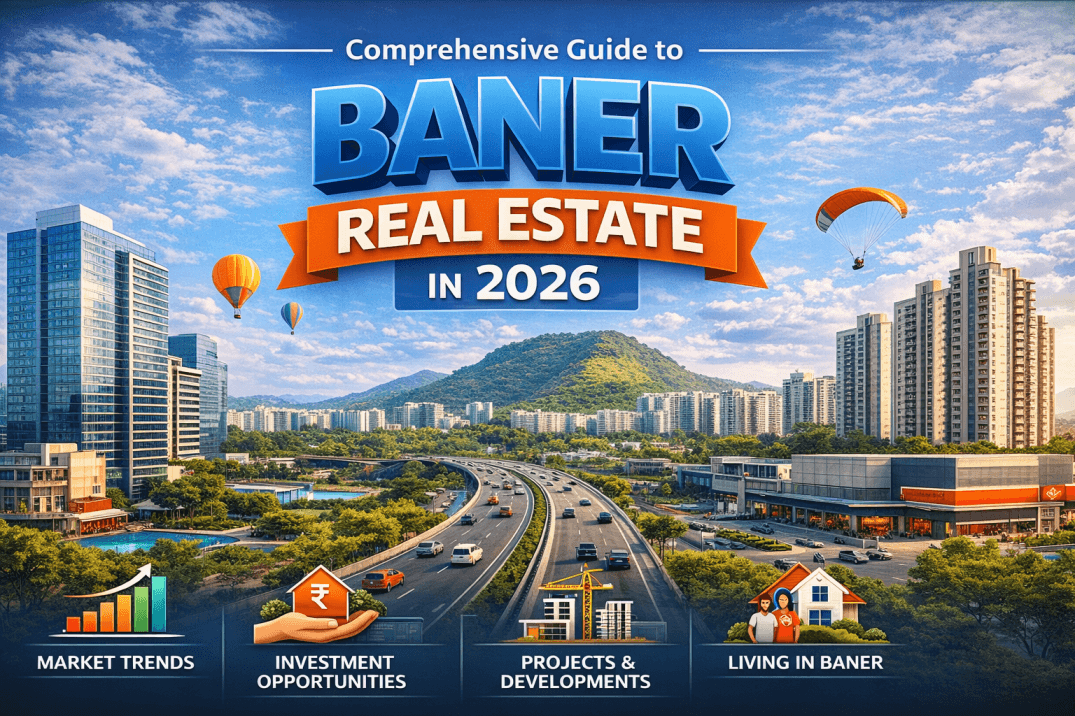
The Complete Guide to Property in Baner, Pune 2026: Investment, Living & Future Outlook
The definitive guide to Baner real estate in 2026. Updated price trends, top residential projects, rental yields, infrastructure status, metro updates, and expert buying tips for investors and homeowners.
Baner Property Investment Tips 2024
Expert tips and strategies for investing in Baner real estate. Learn about price trends, ROI, and best investment options.
Explore Baner
Helpful Resources
Frequently Asked Questions
- What is the best area to buy property in Baner?
- Baner–Balewadi Road is the most balanced zone with strong rental demand and resale liquidity. High Street vicinity suits lifestyle buyers; Pancard Club Road and Baner Hills suit those prioritising peace over buzz.
- What are Baner property prices per sq ft?
- As of the current cycle, Baner residential pricing broadly falls in ₹9,500–₹11,500/sq.ft (resale and edge pockets), ₹11,500–₹13,500/sq.ft (core Baner), and ₹13,500–₹16,000+/sq.ft (premium zones).
- Is RERA required for projects in Baner?
- Yes. Any excuse for "RERA not required" in Baner is unacceptable. Always verify the project RERA number and approved plans on the Maharashtra RERA portal, not builder PDFs.
- Should I buy ready-to-move or under-construction property in Baner?
- Ready-to-move and resale offer maximum certainty and no GST; under-construction has delay and quality risk. Baner rewards certainty—prefer ready or resale unless the project is 60%+ complete and the builder has a clean delivery record.
- How do I verify legal documents when buying in Baner?
- Before token: verify RERA, title (30+ years), NA order, approved plans, and OC if applicable. Use an independent property lawyer. Token paid = leverage lost.
Interested in Baner Properties?
Get expert consultation and site visit assistance from Baner Property.