War Impact on India Real Estate 2026
Quick links
How active conflicts — Operation Sindoor, the Iran war, and ongoing global tensions — are shaping India's property market right now. This is the only article that answers the question buyers are actually asking in March 2026: "Should I buy, wait, or rethink my investment given what's happening in the world?" If you understand this page, you'll make a sharper decision. For the full buying process, see our complete guide to buying property in Baner.
1. The War–Real Estate Reality (Read This First)
Wars don't kill India's property market. They delay it — briefly.
What history consistently shows:
- Short conflicts create a pause, not a collapse
- Pent-up demand releases strongly once tension eases
- End-user markets like Pune recover faster than speculative ones
- Buyers who enter during uncertainty consistently outperform those who wait for certainty
The risk is real. The opportunity is also real. Both need to be understood clearly.
2. The Two Active Conflicts Affecting India Right Now
2.1 Operation Sindoor — India vs Pakistan (May 2025)
What happened:
- 22 April 2025: Pahalgam terror attack kills 26 civilians in J&K
- 7 May 2025: India launches Operation Sindoor — precision missile strikes on terrorist camps in Pakistan and Pakistan-administered Kashmir
- Pakistan retaliates with drone and artillery strikes on Indian border cities
- 10 May 2025: Ceasefire announced — but diplomatic relations remain frozen as of March 2026
- Most serious India-Pakistan military confrontation since Kargil 1999
Real estate impact at the time:
- New property enquiries fell 15–25% during peak conflict week (7–12 May)
- Several developers postponed May 2025 project launches by 4–8 weeks
- Border state markets hit hardest — Amritsar, Ludhiana, Chandigarh saw 30–40% sales drop
- Sensex fell 800+ points; consumer confidence dipped nationally
- Labour migration risk flagged by developers — though actual disruption was limited
What happened after the ceasefire:
- By June–July 2025, residential sales had fully recovered across top 7 cities
- H2 2025 became one of the strongest periods for premium housing sales on record
- Total residential sales value in 2025 hit ₹6 lakh crore — a 6% increase over 2024
- Pune and Bangalore led the post-conflict recovery
2.2 US–Israel War on Iran (February 2026) — Happening Right Now
What is happening:
- 28 February 2026: US and Israel launch joint airstrikes on Iran (Operation Epic Fury)
- Iran retaliates — closes Strait of Hormuz, attacks US military bases in UAE, Qatar, Bahrain
- UAE, Qatar, Kuwait, Bahrain airspace closures ground thousands of flights including India–Gulf routes
- As of 12 March 2026: conflict is in its 12th day and still active
Why this directly affects India:
- 9 million+ Indians live and work in Gulf countries
- Gulf contributes ~38% of India's total remittance inflows — approximately ₹4.3 lakh crore (USD 51 billion) annually
- India imports a significant share of its crude oil through Hormuz-adjacent routes
- S&P Global has warned of "material impact on the Indian economy" if conflict extends beyond 6 months
3. The Three Real Risks for India's Property Market in 2026
3.1 Construction Cost Inflation
- Brent crude spiked above $100/barrel following Hormuz closure
- Diesel prices at construction sites are directly tied to crude — machinery, trucks, generators all run on diesel
- Russia-Ukraine war precedent: India's construction costs rose 10–18% between 2022 and 2023 when oil stayed elevated
- If oil holds above ₹90–100/barrel through mid-2026, new project launch prices in Baner could see 5–10% upward revision
- Ready-to-move and under-construction projects at current prices become relatively more attractive before this revision hits
3.2 NRI Remittance Disruption
- Gulf-based NRIs contribute significantly to Pune's premium residential demand — estimated 15–20% of high-value transactions
- Airspace closures are delaying NRI visits to India — site tours, registrations, deal closures all impacted
- Short-term effect may be a paradox: conflict-driven risk aversion could push NRI savings into Indian real estate faster
- Medium-term risk: if Gulf employment slows due to conflict, remittance volumes fall and NRI buying power reduces
3.3 Consumer Sentiment and Demand Deferral
- War creates a "wait and watch" mindset — buyers don't exit, they pause
- Mid-income and premium segments (₹80L–₹2Cr) show the most resilience — driven by end-use urgency
- Luxury segment (₹5Cr+) is most volatile — these buyers have alternatives like gold, equities, overseas assets
- Post-ceasefire demand decompresses quickly — Operation Sindoor proved this in 2025
4. Historical Proof: India's Real Estate Has Survived Every War
| Conflict | Short-Term Impact | Recovery Timeline | What Followed |
|---|---|---|---|
| Indo-Pak War 1971 | Construction halted, transactions fell sharply | 12–18 months | Strong govt infra spend, market recovery |
| Kargil War 1999 | Rentals dipped 3–8%, luxury paused | 3–4 months | India's first real estate bull run 2000–2007 |
| Russia-Ukraine 2022 | Construction costs up 10–18% | 6–12 months | Record residential sales 2023–2025 |
| Operation Sindoor 2025 | Enquiries fell 15–25%, launches delayed | 6–8 weeks | H2 2025 strongest premium sales on record |
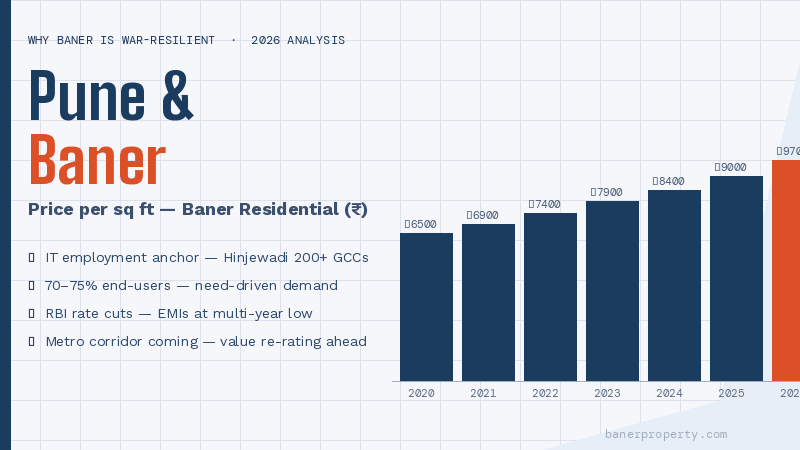
Baner-specific insight: Pune and Baner have outperformed the national recovery in every post-conflict period — driven by IT employment continuity that other markets lack.
5. Why Pune and Baner Are More Insulated Than Most Markets
- IT employment anchor: Infosys, Wipro, Cognizant, Capgemini and 200+ GCCs in Hinjewadi create demand that is not linked to geopolitical events
- End-user driven: 70–75% of buyers in Baner are end-users, not investors — their housing need doesn't disappear because of a war
- Geography: Distance from border states means conflict-zone fear premium does not apply
- NRI demand: Gulf-based NRI buyers view Pune property as a safe haven — conflict can accelerate, not suppress, this demand in the short run
- Infrastructure pipeline: Pune Metro extension to Baner and Hinjewadi remains on track — infrastructure-led value creation continues regardless of external conflict
During Operation Sindoor's peak (7–12 May 2025), Pune property registrations declined only marginally. By June 2025, the market had fully normalised.
6. Sector-Wise Impact in India's Real Estate
6.1 Residential — Most Resilient
- Demand pauses, not disappears
- Mid-premium (₹80L–₹2Cr) most stable — end-use urgency dominates
- Luxury (₹5Cr+) most volatile — buyers have alternatives
- Post-conflict recovery is consistently sharp due to pent-up demand release
6.2 Commercial — Sensitive but Bouncing Back
- MNC deal closures slow during conflict; short-term and flexible leases preferred
- India office absorption hit a historic 61 million sq ft in 2025 — despite Operation Sindoor
- Pune and Bangalore GCC-driven demand continues structurally regardless of conflict
6.3 Industrial & Warehousing — Unexpected Beneficiary
- Global supply chain reshuffling (China+1, Gulf conflict alternatives) drives India industrial demand
- 26.5 million sq ft absorbed in first 9 months of 2025 — up 11% YoY
- War accelerates this trend, not reverses it
6.4 Hospitality — Most Vulnerable
- Foreign arrivals drop immediately during conflict
- Gulf airspace closures are directly hitting India-Gulf travel and hotel bookings
- Urban business hotels in Pune and Bangalore — not dependent on foreign tourists — more insulated
7. What's Happening to Baner Property Prices Right Now
- Current price band: ₹9,500–₹16,000+/sq ft depending on micro-location (unchanged from pre-conflict)
- No price correction has occurred — Baner is not a conflict-sensitive market
- Construction cost pressure from oil price spike may push new launch prices up 5–10% by Q3 2026
- Ready-to-move and advanced-stage under-construction properties are currently the most price-efficient window
- Resale market remains active — sellers are not distress-pricing due to conflict
If you're waiting for a war-driven price crash in Baner, the data says it isn't coming. What is coming is a cost-driven upward revision as oil inflation filters into developer pricing.
8. Clear Signals That Should Make You Pause (Real Red Flags)
- Conflict extends beyond 6 months — structural employment damage becomes a risk
- Gulf remittances fall significantly — NRI demand segment shrinks
- Oil holds above $100/barrel through Q2-Q3 2026 — new launch prices revise upward materially
- India-Pakistan ceasefire breaks down — renewed military escalation is a low-probability but high-impact tail risk
- RBI reverses rate cuts due to inflation pressure from oil — home loan EMIs become less affordable
Rule: Watch for these signals. None of them are happening today. If they materialise, reassess. Until then, the fundamentals favour buying.
9. The 2026 Market Outlook for Baner Buyers
- Price appreciation: 7–10% expected in 2026 — construction cost pressure is actually a floor, not a ceiling
- Metro connectivity: Baner–Hinjewadi Metro corridor completion will re-rate currently undervalued pockets
- NRI demand: Gulf uncertainty may accelerate India repatriation of NRI savings — Pune a top destination
- Institutional confidence: USD 7.5 billion institutional investment into Indian real estate in 2025 — an all-time record — signals that smart money is not running from India's property market
- RBI support: 100+ bps rate cuts in 2025 have reduced effective home loan rates — EMI affordability is at a multi-year high
10. What Smart Buyers Do Right Now
They don't ask: "Should I wait for the war to end?"
They ask: "Is this property in the right micro-location, at the right price, with the right developer — independent of what's happening geopolitically?"
That question saves lakhs — and protects against overpaying at post-conflict peak prices when everyone else rushes back in.
Before finalising any Baner deal in this environment:
- Validate the micro-location — is it end-user driven or speculative?
- Check developer financials — over-leveraged builders face greater risk during cost inflation cycles
- Prefer ready-to-move or advanced construction stage — locks in today's price before oil-driven revisions
- If NRI: act before Gulf airspace fully normalises — buying window with less competition is now
Because in Baner, entering at the right moment during uncertainty is smart — waiting for certainty means paying the certainty premium. To understand exactly what you should pay by micro-location, read our Baner property prices 2026 guide; to avoid costly errors in any market condition, see common mistakes when buying in Baner.
Featured Properties in Baner

Related Articles

The Complete Guide to Property in Baner, Pune 2026: Investment, Living & Future Outlook
The definitive guide to Baner real estate in 2026. Updated price trends, top residential projects, rental yields, infrastructure status, metro updates, and expert buying tips for investors and homeowners.
Complete Guide to Buying Property in Baner, Pune (2026 Edition)
A detailed step-by-step guide to buying property in Baner, Pune. Covers prices, legal checks, ROI, builders, loans, and expert insights.

Baner Property Investment Tips 2024
Expert tips and strategies for investing in Baner real estate. Learn about price trends, ROI, and best investment options.
Explore Baner
Helpful Resources
Interested in Baner Properties?
Get expert consultation and site visit assistance from Baner Property.