Flat Prices in Baner 2025–26: Locality-by-Locality Breakdown (With Real Numbers)
Quick links
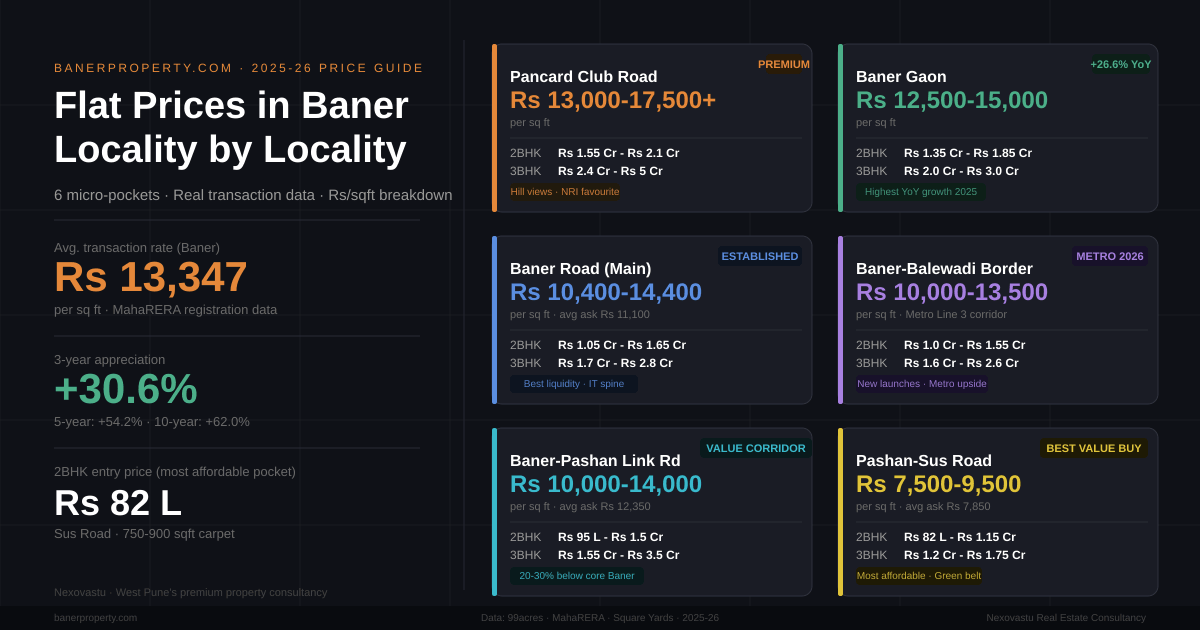
This is the one page a Baner buyer should read before talking to any broker or visiting any site. It breaks down exactly what you will pay, pocket by pocket, configuration by configuration — no vague ranges, no marketing speak. If you are comparing Baner Road to Pancard Club Road, or trying to decide whether Baner-Pashan Link Road is worth its lower entry price, this guide answers those questions with actual numbers from 2025–26 transaction data and current listings. For context on what the full buying journey looks like, see our complete guide to buying property in Baner.
1. Why Baner Has a Price Spectrum, Not a Single Price
Most people searching for "flat prices in Baner" come away confused. They find listings from ₹85 lakh to ₹5 crore — all described as "Baner." That is not misleading. It is accurate. Baner is not one micro-market. It is a collection of at least six distinct sub-localities, each with its own price logic, buyer profile, infrastructure access, and appreciation trajectory.
The six pockets that matter for a residential buyer in 2026 are:
- Baner Road (Main) — the original commercial and residential spine of Baner
- Pancard Club Road — the premium hill-facing pocket, the most sought-after address in Baner
- Baner-Pashan Link Road (BPLR) — the value corridor between Baner and Pashan
- Pashan-Sus Road — the quietest and most undervalued of the Baner-adjacent pockets
- Baner Gaon — the old village core, highest appreciation last year, mixed character
- Baner-Balewadi Border / Balewadi Phata — the fastest-growing new-launch corridor
Each of these pockets deserves its own price analysis. That is exactly what this guide provides — room by room, rupee by rupee.
Before we go locality by locality, here is the Baner-wide headline number for 2026: The average transaction rate of a flat in Baner as per Maharashtra government registration data stands at approximately ₹13,347 per sq ft. The listed/asking rate on property platforms averages ₹11,100–₹12,000 per sq ft. The gap between these two numbers is important — it reflects a market where new launches and premium projects command a significant premium over older stock. Understanding this gap, and which pocket you are buying in, is the entire value of this guide.
2. The Baner Price Map: Pocket-by-Pocket Overview
| Micro-Pocket | Price Range (₹/sqft) | Typical 2BHK (All-In) | Typical 3BHK (All-In) | Character |
|---|---|---|---|---|
| Pancard Club Road | ₹13,000–₹17,500+ | ₹1.55 Cr – ₹2.1 Cr | ₹2.4 Cr – ₹5 Cr | Premium / Luxury hill address |
| Baner Gaon | ₹12,500–₹15,000 | ₹1.35 Cr – ₹1.85 Cr | ₹2.0 Cr – ₹3.0 Cr | Highest YoY appreciation (26.6%) |
| Baner Road (Main) | ₹10,400–₹14,400 | ₹1.1 Cr – ₹1.65 Cr | ₹1.7 Cr – ₹2.8 Cr | Established, high liquidity |
| Baner-Balewadi Border | ₹10,000–₹13,500 | ₹1.0 Cr – ₹1.55 Cr | ₹1.6 Cr – ₹2.6 Cr | Metro corridor, new launches |
| Baner-Pashan Link Road | ₹10,000–₹14,000 | ₹95 L – ₹1.5 Cr | ₹1.55 Cr – ₹3.5 Cr | Value corridor, green views |
| Pashan-Sus Road | ₹7,500–₹9,500 | ₹82 L – ₹1.15 Cr | ₹1.2 Cr – ₹1.75 Cr | Most affordable, best value-buy |
The numbers above are based on current market listings and recent government-registered transactions. They are not developer marketing rates — those routinely run 8–15% above actual transaction values. Use these as your anchor when negotiating.
3. Pancard Club Road — Baner's Premium Address
If you have heard someone say they "bought in Baner" and paid ₹3 crore or more for a 3BHK, they almost certainly bought on or near Pancard Club Road. This stretch — running from the Pan Card Club junction up toward the Baner hills — is the most sought-after residential address in all of West Pune, and it prices accordingly.
Why it commands a premium:
- Hill-facing views and proximity to Baner Biodiversity Park — the only green lung left in this part of Pune
- Home to Pune's most prestigious residential projects: Nyati Emerald, Kalpataru Jade Skyline, Lodha Massimo, Kolte Patil 24k Altura, Majestique Exclusive 90, ANP Baner Hills
- Low-density, large-format projects dominating — no cramped builder-floor market here
- The highest concentration of end-users rather than investors, which creates pricing stability
- NRI buyers disproportionately choose this pocket — the address recognition factor is real
Current price reality in 2026:
- Standard 2BHK (900–1,100 sq ft carpet): ₹1.55 Cr to ₹2.1 Cr in established projects
- 3BHK (1,200–1,500 sq ft carpet): ₹2.4 Cr to ₹4 Cr depending on floor and view
- Large-format 4BHK and premium 3BHK in ultra-luxury projects (Kolte Patil 24k Altura, ANP Privado): ₹4 Cr to ₹5 Cr+
- Price per sq ft for new launches: ₹15,000–₹17,500+
- Resale market (5–8 year old projects): ₹13,000–₹15,500 per sq ft
Most transacted projects (by volume, per Maharashtra Govt data): Nyati Emerald leads with approximately 182 transactions recorded in the last year — the highest of any project in Baner — followed by Kalpataru Jade Skyline at 98 transactions and Lodha Massimo at 96. These numbers tell you something important: this pocket has genuine buyer conviction, not just listing activity.
Who should buy here: Buyers with a budget above ₹1.7 Cr for 2BHK or ₹2.5 Cr for 3BHK who prioritise long-term capital appreciation, NRI buyers seeking a recognised Pune address, and anyone who values proximity to the hills and a quieter, greener living environment over walkable urban conveniences.
Who should look elsewhere: First-time buyers on a tighter budget. Buyers who need maximum walkable infrastructure (daily markets, schools at walking distance). Under ₹1.5 Cr, this pocket simply does not offer good value — you get outdated stock or very small configurations at that price point.
Baner Property's honest view: Pancard Club Road is the most defensible investment in Baner. Prices here have held through every market cycle because the land is genuinely scarce — the hills create a hard boundary — and the buyer profile is almost exclusively end-user. The risk of price correction here is lower than anywhere else in the Baner ecosystem. But you pay for that safety premium upfront.
4. Baner Gaon — The Surprise Performer of 2025
Baner Gaon is the old village core of what was once an agricultural hamlet before Pune's westward expansion swallowed it. Today it is a mixed-character locality: narrow lanes and old village homes sit alongside modern high-rises, and that collision creates a unique pricing dynamic.
In 2025, Baner Gaon was the single highest appreciating sub-pocket in the Baner ecosystem, with year-on-year apartment price growth of 26.6% according to 99acres data. That is not a typo. While the broader Baner market showed more moderate movement, this particular pocket outperformed significantly — driven by buyers who discovered they could get a Baner-address property at prices 10–15% below the main Baner Road market.
Current price reality in 2026:
- Average transaction rate: ₹13,550 per sq ft (per 99acres market data)
- 2BHK (850–1,050 sq ft carpet): ₹1.25 Cr to ₹1.85 Cr
- 3BHK (1,150–1,450 sq ft carpet): ₹1.9 Cr to ₹3.0 Cr
- Rental yield: Monthly rents for 2BHK range ₹20,000–₹30,000; for 3BHK, ₹40,000–₹55,000
What drives the high appreciation: Baner Gaon's price surge in 2025 was not random. A combination of spillover demand from the overcrowded Baner Road market, proximity to Pancard Club Road's premium ecosystem, and a genuine scarcity of quality inventory all pushed prices up sharply. When demand exceeds supply in a locality with limited developable land (as is the case in the old village core), prices move fast.
The trade-offs buyers must understand:
- Infrastructure quality is uneven — modern high-rises sit next to older, poorly-maintained lanes
- Road width is genuinely narrow in the inner lanes — car access can be frustrating
- Water supply is less reliable than in planned sectors of Baner; many buildings rely on tankers in summer
- Resident reviews consistently flag open drainage, inconsistent garbage collection, and parking challenges
Baner Property's honest view: Baner Gaon is a buy for the right buyer — one who values a Baner address at a relative discount, is comfortable with the village-town infrastructure hybrid, and has the holding patience to wait for the pocket to be further regularised. The 26.6% appreciation in 2025 is impressive, but buyers should not count on that repeating. That was a catch-up move after years of undervaluation. The base is now higher. From here, appreciation will likely normalise to the broader Baner trajectory of 8–12% annually. That is still strong, but not the same story as 2025.
5. Baner Road (Main) — The Established Core
When most people say "Baner," they mean Baner Road and its immediate surroundings. This is the original spine of the locality — the stretch from the Baner Phata signal all the way toward Balewadi High Street — lined with restaurants, gyms, co-working spaces, ATMs, clinics, and grocery stores. It is Baner's most livable zone for someone who wants everything at arm's length.
Current price reality in 2026:
- Listed asking price range: ₹10,400–₹14,400 per sq ft (99acres data)
- Average asking rate: ₹11,100 per sq ft
- Average government-registered transaction rate: ₹13,347 per sq ft — a significant gap from listed prices, reflecting that actual sales in quality projects transact substantially above average asking prices
- 1BHK (500–700 sq ft carpet): ₹47 L to ₹95 L
- 2BHK (850–1,150 sq ft carpet): ₹1.05 Cr to ₹1.65 Cr
- 3BHK (1,200–1,600 sq ft carpet): ₹1.7 Cr to ₹2.8 Cr
- Luxury 3BHK/4BHK in premium projects: ₹3 Cr to ₹4.5 Cr
The gap between ₹10,400 and ₹14,400 — what creates it: This range is not misleading. It reflects real differences in project quality, age, floor, view, and developer reputation. A 2BHK in a 10-year-old project by a small developer on a narrow internal road will transact at ₹10,400–₹11,500 per sq ft. A 2BHK in a new Godrej, Kalpataru, or VTP project with modern amenities, higher floors, and good views will transact at ₹13,000–₹14,400 per sq ft or above. Knowing which side of this spectrum you are buying on — and why — is the most important due diligence exercise for a Baner Road buyer.
5-year and 10-year appreciation data (Baner aggregate):
- 3-year appreciation: 30.6%
- 5-year appreciation: 54.2%
- 10-year appreciation: 62.0%
These numbers confirm that Baner Road is not a speculative market — it is a steady wealth creator. Buyers who entered 5 years ago have seen their investment grow by over 50% in nominal terms, a performance that comfortably outpaces fixed deposits and most equity indices adjusted for the same risk profile.
Rental market snapshot: Baner Road's rental market is one of the most active in West Pune, driven by IT professionals working in Hinjewadi (12–20 minutes away), Baner-based offices, and students at nearby colleges. Average monthly rentals as of early 2026:
- 1BHK: ₹15,000–₹22,000/month
- 2BHK: ₹22,000–₹40,000/month (furnished)
- 3BHK: ₹40,000–₹65,000/month (furnished)
Baner Property's honest view: Baner Road is the safest and most liquid part of the Baner market. If you ever need to sell, you will find buyers fastest here because it is the pocket people know best. The trade-off is that you pay the full Baner premium with no discount for being an "emerging" area. This is an established market — prices reflect that. For pure end-use buyers who want the full Baner lifestyle, this is the right pocket. For value-seeking investors willing to hold 4–5 years, the Baner-Pashan Link Road or Pashan-Sus Road offer better entry prices with comparable upside.
6. Baner-Balewadi Border / Balewadi Phata — The Metro Pocket
The stretch where Baner bleeds into Balewadi — around Balewadi Phata, Balewadi High Street, and the Laxman Nagar area — is undergoing the most dramatic transformation in all of West Pune in 2026. The reason: Pune Metro Line 3 (the Pink Line) running from Hinjewadi to Shivajinagar passes directly through this corridor, with the Balewadi Stadium station and adjacent stations creating a new transit-oriented real estate premium.
Metro Line 3 status (as of March 2026): The Hinjewadi to Baner section (approximately 11.4 km, 12 stations) was expected to open for public use between December 2025 and January 2026. Full commercial operations across the entire 23.3 km corridor are scheduled for May 2026. Trial runs have been extended up to Baner station with signaling, automated train controls, and station infrastructure evaluations completed. This is not a "future" catalyst — it is an imminent one.
Current price reality in 2026:
- Price per sq ft: ₹10,000–₹13,500
- 2BHK (800–1,100 sq ft carpet): ₹1.0 Cr to ₹1.55 Cr
- 3BHK (1,100–1,500 sq ft carpet): ₹1.6 Cr to ₹2.6 Cr
- New launches in proximity to metro stations: ₹12,000–₹14,000 per sq ft
The metro premium — what the data says: Properties within 500 metres of metro stations in Pune have seen 15–25% annual appreciation in 2025 according to multiple market reports, versus 8–12% for comparable properties farther from stations. PMRDA projects a total ₹5,000–7,000 crore uplift in property values along the Line 3 corridor through 2027. Premium projects with "walk-to-metro" positioning are already commanding a 10–15% premium over comparable non-metro-adjacent projects in the same micro-market.
Key projects in this corridor:
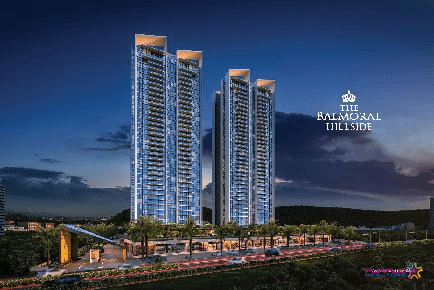
- Kasturi The Balmoral Riverside (Balewadi) — 3 and 4BHK, ₹2.7 Cr to ₹5 Cr, possession Dec 2027
- Majestique Exclusive 90 (Pancard Road, Baner side) — 4BHK, ₹3.8 Cr to ₹5 Cr
- Kakkad La Vida — 2 and 3BHK, ₹79 L to ₹1.3 Cr (Balewadi, slightly below the Baner premium)
Baner Property's honest view: This is the most interesting buying opportunity in the Baner-adjacent ecosystem right now. The metro premium is real, and it is not yet fully priced in — you are still buying ahead of full operational launch. The risk is construction delays (the metro has already slipped from its original 2025 deadline) and the fact that "metro adjacency" varies enormously — 500m walk-to-station is very different from 2km. Verify the actual station location and walking route before paying the metro premium. Projects that are genuinely 5–7 minutes on foot from a station justify the premium. Projects that require a feeder rickshaw to reach the station do not.
7. Baner-Pashan Link Road (BPLR) — The Value Corridor
Baner-Pashan Link Road is the road that connects Baner's western edge to Pashan, running alongside the Baner Biodiversity Park and offering some of the most scenic views available in West Pune's residential market. It is neither fully Baner nor fully Pashan — which is exactly why it is priced below both, and why smart buyers have been quietly accumulating here.
Current price reality in 2026:
- Average asking price: ₹12,350 per sq ft (99acres data)
- New launches and premium projects: ₹13,000–₹14,000 per sq ft
- Established stock (5+ years old): ₹10,000–₹12,000 per sq ft
- 2BHK (800–1,100 sq ft carpet): ₹95 L to ₹1.5 Cr
- 3BHK (1,200–1,500 sq ft carpet): ₹1.55 Cr to ₹3.5 Cr
- Large-format 4BHK (Kalash Montage): ₹2.5 Cr to ₹3.5 Cr, possession July 2026
The pricing gap versus core Baner: As of 2025, developments in core Baner are priced upwards of ₹15,000 per sq ft for new launches, while similar-quality projects on BPLR sit at ₹10,000–₹12,000 per sq ft. That is a 20–30% discount for a location that is literally 5–10 minutes away from Baner's daily amenities by car, adjacent to the Biodiversity Park, and connected to Aundh, Balewadi, and Sus Road.
Infrastructure highlights:
- Direct access to Hinjewadi IT Park via Wakad — approximately 20–25 minutes
- Vanaz metro station and Anand Nagar metro station are the nearest commute options — meaning BPLR benefits from metro connectivity without paying the Baner mainline premium
- Pune University Square flyover targeted for completion in 2026, which will ease traffic to Shivajinagar, Aundh, Baner, and Pashan — directly benefiting BPLR commuters
- Proximity to Ryan International School, NICMAR, and GS Moze College within 3 km
- Jupiter Hospital and Samarth Hospital within 3 km
Lifestyle trade-offs: BPLR is quieter, greener, and less congested than Baner Road. It is not a "walk everywhere" locality — you will need to drive or cab to reach the restaurants, gyms, and retail outlets that make Baner famous. But for buyers who prefer a peaceful environment over urban buzz, this is a feature, not a bug.
Rental yield on BPLR: Monthly rental asks for premium properties on BPLR range from ₹28,300–₹38,800, which on an investment of ₹1.2–1.8 Cr translates to a rental yield of roughly 2.5–3.0%. Not the highest in the ecosystem, but reasonable for a locality at this price point. As metro connectivity matures, rental demand from IT professionals is expected to increase, pushing yields toward the 3.5% range.
Baner Property's honest view: BPLR is the best value-buy in the Baner ecosystem for a buyer who is not fixated on a "Baner Road" address but wants the Baner quality of life, green surroundings, and long-term appreciation. The 20–30% entry price discount versus core Baner will compress as infrastructure improves and the market's familiarity with BPLR grows. First-time buyers with a budget of ₹1–1.5 Cr, and investors with a 5-year horizon, should look here seriously before settling for a smaller or older flat on Baner Road at the same price.
8. Pashan-Sus Road — The Most Undervalued Pocket Adjacent to Baner
Pashan-Sus Road is the locality that Baner buyers discover last — usually when their budget runs out. And that is a mistake, because Sus Road deserves to be evaluated on its own merits, not as a consolation prize.
Current price reality in 2026:
- Average asking price: ₹7,850 per sq ft (99acres data) — the lowest in the Baner-adjacent ecosystem
- 2BHK (750–1,050 sq ft carpet): ₹82 L to ₹1.15 Cr
- 3BHK (1,100–1,400 sq ft carpet): ₹1.2 Cr to ₹1.75 Cr
- New launch 3BHK projects (Vilas Javdekar Prime Heights): ₹1.4 Cr
What ₹7,850/sqft on Sus Road gives you that ₹13,000+/sqft on Baner Road does not:
- Significantly more space for the same budget — a 1,100 sq ft 3BHK on Sus Road at ₹1.3 Cr versus a 900 sq ft 2BHK on Baner Road at the same price
- A quieter, less congested neighbourhood with better air quality
- Lush greenery — Sus Road is bordered by open land, hills, and agricultural areas that have not yet been fully developed
- Proximity to Pashan Lake and the Pashan-Sus natural environment
The connectivity case: Sus Road connects to Baner-Pashan Link Road, which in turn connects to Baner, Aundh, Pashan, and the Mumbai-Bangalore Highway. Vanaz metro station is the nearest metro connectivity point. Hinjewadi IT Park is 20–30 minutes by road. This is not a remote location — it is an underpriced location relative to its neighbours.
The honest trade-offs:
- Social infrastructure is noticeably thinner — fewer restaurants, malls, and daily conveniences within walking distance compared to Baner Road
- The market here has actually seen a 3.7% price correction over the last year — it is the only Baner-adjacent pocket currently in slight negative territory on a 1-year basis
- Resale liquidity is lower — if you need to sell quickly, finding a buyer will take longer than on Baner Road
- Narrow road segments and limited parking in some parts of the older Sus Road stock
Baner Property's honest view: Sus Road's 1-year price correction is a buying signal, not a warning — if you have the right profile. This pocket is structurally well-positioned: adjacent to the appreciated Baner-Pashan Link Road market, near major employment corridors, and at a price point that is simply not replicable anywhere else in the Baner ecosystem. The 3.7% YoY decline reflects lower transaction volumes and limited new project launches, not a demand problem. As the BPLR corridor matures and prices there rise further, spillover demand will find Sus Road an increasingly attractive entry point. For buyers with budgets under ₹1.2 Cr who want a 3BHK in the Baner vicinity, Sus Road is the most rational answer available in 2026.
9. The 2BHK vs 3BHK Decision in Baner — The Numbers
One of the most common questions Baner Property gets is: "Should I stretch for a 3BHK or stay comfortable with a 2BHK?" The answer is not financial — it is personal, informed by financial data. Here is what the numbers actually say.
Current 2BHK market in Baner (2026):
- Carpet area typically offered: 750–1,100 sq ft (configurations vary widely by project)
- Price range across all Baner pockets: ₹85 L to ₹1.95 Cr
- Most transacted price band: ₹1.0 Cr – ₹1.55 Cr
- Average monthly rent achievable: ₹22,000–₹40,000 (depending on pocket and furnishing)
- Typical resale timeline if held 5 years from today: ₹1.4 Cr – ₹2.2 Cr (at 8–10% CAGR)
Current 3BHK market in Baner (2026):
- Carpet area typically offered: 1,100–1,600 sq ft
- Price range across all Baner pockets: ₹1.42 Cr to ₹5 Cr+
- Most transacted price band: ₹1.9 Cr – ₹3.0 Cr
- Average monthly rent achievable: ₹40,000–₹70,000 (depending on pocket and furnishing)
- Typical resale timeline if held 5 years: Proportionally higher, but 3BHKs tend to appreciate slightly faster in premium pockets as the buyer pool for this configuration is growing
The EMI comparison (at current 8.5% home loan rate, 20-year tenure):
| Configuration | Typical Price | Loan Amount (80%) | Monthly EMI (approx.) | Monthly Rent Achievable |
|---|---|---|---|---|
| 2BHK (Baner Road) | ₹1.3 Cr | ₹1.04 Cr | ~₹90,500 | ₹28,000–₹35,000 |
| 3BHK (Baner Road) | ₹2.2 Cr | ₹1.76 Cr | ~₹1,53,000 | ₹50,000–₹65,000 |
| 2BHK (Sus Road) | ₹95 L | ₹76 L | ~₹66,200 | ₹18,000–₹24,000 |
| 3BHK (BPLR) | ₹1.7 Cr | ₹1.36 Cr | ~₹1,18,400 | ₹35,000–₹45,000 |
The rule of thumb that actually works: In Baner, rental income covers approximately 25–35% of your EMI on a freshly purchased flat. That gap — the 65–75% of EMI that rental income does not cover — is the real cost of ownership. It is not a reason to not buy, but it is a number you must budget for. The narrower you can make that gap (by choosing a lower entry-price pocket or a higher-yielding configuration), the more financially comfortable your ownership journey will be.
Baner Property's recommendation: If your household income is ₹1.8 lakh/month or above and you genuinely need the space, the 3BHK in the ₹1.8–2.2 Cr range (Baner Road or BPLR) is the better long-term investment because family configuration demand in Baner is growing as the locality matures. If your income is ₹1.2–1.6 lakh/month and you are buying primarily for end-use, the 2BHK in the ₹1.0–1.3 Cr range gives you a more comfortable EMI-to-income ratio and Baner-quality living without overextending.
10. Ready-to-Move vs Under-Construction: What the Baner Market Says
This is the most practical decision a Baner buyer faces in 2026, and the answer has shifted from what it was even two years ago.
The ready-to-move (RTM) case in Baner 2026:
- No GST on RTM properties (saves 5% on under-construction cost)
- What you see is what you get — floor, view, actual carpet area, actual quality
- Immediate rental income — critical for investors who want yield from day one
- Risk-free in terms of delivery — a completed building cannot "miss possession"
- RERA now covers resale of recently completed projects, so legal protection is comparable
The under-construction (UC) case in Baner 2026:
- Lower entry price — new launches in Baner are typically priced 8–12% below the projected RTM market price at the time of possession
- Construction-linked payment plan — you spread payments over 2–3 years, reducing the burden on your current savings
- Lock-in at today's price before oil-driven construction cost inflation pushes new launch prices up 5–10% by Q3 2026 — a real risk given current crude prices
- Choice of floor and orientation — something RTM rarely offers
The risk landscape for UC in Baner specifically: Baner has a strong developer ecosystem — Godrej, Kalpataru, Kolte Patil, Nyati, VTP, Lodha, Kumar Properties are all active here. These are well-capitalised developers with strong RERA compliance track records. The risk of a delivery default is meaningfully lower in Baner than in peripheral Pune markets with smaller developer bases. That said, always verify the developer's RERA MahaRERA compliance at maharera.mahaonline.gov.in before signing anything.
Nexovastu's view: In 2026, the choice depends on your timeline. If you are buying for immediate occupancy or rental income, go RTM. If you have 2–3 years of flexibility and want to lock in the best price before construction costs revise upward, the UC window — particularly in BPLR and Baner-Balewadi border projects — is genuinely attractive right now. The sweet spot is advanced-stage under-construction (60–80% complete) — you get a price between new launch and RTM, with a short possession timeline and visible physical progress reducing execution risk.
11. What IT Professionals and NRI Buyers Should Know
Two buyer segments drive Baner's premium market disproportionately: IT professionals based in Hinjewadi and the Baner-Balewadi office corridor, and NRI buyers with family connections in Pune. Both segments have distinct considerations that generic property guides miss.
For IT professionals:
- The Hinjewadi commute question dominates. Without Metro Line 3, Hinjewadi to Baner road commute is 25–40 minutes depending on traffic — manageable for most. With Metro Line 3 operational (full launch May 2026), the same commute drops to 15–20 minutes from stations near Baner — a significant quality-of-life upgrade that will push demand in metro-adjacent pockets
- IT professionals typically seek 2BHK or 3BHK in the ₹1.2–2.5 Cr range — the core Baner market is well-calibrated for this buyer profile
- Many IT buyers are HRA-claiming renters who are now crossing the crossover threshold where buying makes more financial sense than renting — at current home loan rates (8.5% effective) and Baner rents (₹25,000–₹40,000/month for 2BHK), buying is the right call for anyone planning to stay in Pune 5+ years
- GCC (Global Capability Centre) expansion in Baner and Balewadi — with Infosys, Wipro, Cognizant, Capgemini and 200+ GCCs anchored in nearby Hinjewadi — creates structural employment continuity regardless of global economic cycles
For NRI buyers:
- NRIs from Gulf countries currently face an unusual buying window: Gulf airspace disruptions (following the Iran conflict in February 2026) mean fewer competing NRI buyers are physically present for site visits and registrations — paradoxically creating a less competitive buying environment for those who can conduct due diligence remotely or visit during a brief India trip
- The rupee value of the investment is supported by RBI's recent rate cuts — effective home loan rates are at a multi-year low, meaning NRIs who finance partly through Indian loans benefit from improved EMI affordability
- Pancard Club Road and the premium Baner Road projects are the NRI-preferred pockets — not just for lifestyle appeal but because these are the easiest to rent out to senior IT professionals and expats, ensuring rental continuity during periods when the NRI buyer cannot personally manage the property
- For NRI-specific registration and legal guidance in Baner, explore our new projects in Baner
12. The 5 Most Common Pricing Mistakes Baner Buyers Make
After hundreds of Baner transactions, these are the five errors that cost buyers the most money.
Mistake 1: Comparing carpet area prices across different projects without normalising for loading factor. A developer quoting ₹11,000 per sq ft on "super built-up area" and another quoting ₹13,000 per sq ft on "carpet area" may be offering the same effective price per usable square foot. Always convert to carpet area before comparing. RERA mandates carpet area disclosure — always use that number.
Mistake 2: Believing the developer's possession timeline without checking their RERA track record. All new launches in Baner are RERA-registered, but RERA registration does not guarantee on-time delivery. Check the developer's past project delivery record on MahaRERA before committing to an under-construction project. Delayed possession is not just inconvenient — it means two years of EMI without rental income.
Mistake 3: Not accounting for the all-in cost beyond the BSP (Basic Sale Price). In most Baner projects, the all-in cost is 20–30% higher than the quoted BSP. Typical add-ons include: stamp duty and registration (6–7% in Maharashtra), GST on under-construction properties (5%), parking (₹4–8 lakh depending on project), society formation charges, maintenance deposits, and amenity premiums. A ₹1.5 Cr BSP flat in Baner often closes at ₹1.75–1.8 Cr all-in. Budget accordingly.
Mistake 4: Overpaying for a "Baner" address when a BPLR or Sus Road flat would serve the same end-use need at 20% lower cost. Brand recognition should not drive a ₹25–30 lakh premium. If you will spend 90% of your time inside the flat and the commute distance is identical, the pocket name on the postal address is costing you real money.
Mistake 5: Buying in the wrong phase of a multi-phase project without understanding what "Phase 1 advantage" actually means. Developers price Phase 1 of a project lower to generate early cash flow. By the time Phase 3 launches (typically 2–3 years later), prices in the same project are 15–25% higher. Phase 1 buyers benefit from this appreciation even without the market moving. But this only works if you choose a developer with a strong execution track record. A discounted Phase 1 in a project that gets delayed or stalled costs you far more than the discount saved.
13. The Baner Price Appreciation Forecast — 2026 and Beyond
Forecasting is an imprecise art. But the structural drivers for Baner's appreciation are visible enough to make a calibrated estimate:
Short-term (2026): Price appreciation of 7–10% expected in Baner aggregate. The primary driver is construction cost inflation as oil prices remain elevated following the Iran conflict — new launches will price higher to maintain developer margins, pulling the overall market baseline upward. RTM and advanced-stage UC properties are currently the most price-efficient window before this revision hits.
Medium-term (2027–2028): Metro Line 3 full operations will create a distinct "metro premium" in the Baner-Balewadi corridor — properties within 500m of operational stations could see 15–20% appreciation over and above the base market rate in this period. Baner-Pashan Link Road, positioned between two active metro corridors, is set to benefit from a compression of its discount versus core Baner Road.
Long-term structural driver: Baner sits at the intersection of Pune's largest employment corridor (Hinjewadi) and its most connected expressway access (Mumbai-Bangalore Highway / NH-48). That geographic advantage does not erode with time — it compounds. The 62% appreciation seen over 10 years in Baner aggregate is not an anomaly. It reflects this structural positioning. There is no reason to expect this long-term trajectory to break absent a major disruption to Pune's IT employment base, which — with 200+ GCCs anchored in the corridor — is not a credible near-term scenario.
The one risk worth watching: If RBI reverses its 2025 rate cuts due to oil-driven inflation, effective home loan rates could climb from the current 8.5% toward 9.5–10%. That would reduce buyer affordability across all Baner configurations and moderate demand. Watch RBI Monetary Policy Committee meetings in April and June 2026 for early signals on this front.
14. The Baner Value Heat Map — Where to Buy for Your Budget
Use this as your starting point.
Budget under ₹90 lakhs: Your Baner options are limited to very old stock or very small configurations. A better use of this budget is Pashan-Sus Road (2BHK, 850–950 sq ft carpet) or Wakad (similarly sized 2BHK). Within the Baner ecosystem, look at pre-launch micro-projects in Baner Gaon or BPLR where small developers occasionally offer this price band. Verify RERA registration before committing to anything at this price in Baner.
Budget ₹90 L – ₹1.3 Cr: This is the entry point for a genuine quality 2BHK in the Baner ecosystem. Best options: Pashan-Sus Road (spacious 2BHK in good societies), BPLR (entry-level 2BHK with green views), or Baner Road (compact 2BHK in older but well-maintained stock). Avoid paying ₹1.25+ Cr for a 2BHK in a 10-year-old project without swimming pool or quality amenities — you are paying a location premium for an outdated product.
Budget ₹1.3 Cr – ₹1.8 Cr: This is the sweet spot for a good 2BHK on Baner Road, a well-configured 3BHK on BPLR or Sus Road, or an entry-level 3BHK in the Baner-Balewadi corridor. At this budget, BPLR offers the best value per square foot in the ecosystem. Worth comparing 3 options: one RTM on Baner Road, one UC on BPLR, and one RTM on Sus Road. The differences in carpet area, quality, and long-term appreciation between these three will inform a much sharper decision.
Budget ₹1.8 Cr – ₹2.8 Cr: You are in the core Baner market now. Best options: 3BHK on Baner Road in a quality project (Godrej, Nyati, VTP), or 3BHK on Pancard Club Road in a well-established society. This budget is also sufficient for a premium 3BHK on BPLR in new launches. Priority at this budget: developer quality, floor, and view — the price differences between good and mediocre projects at this budget range are smaller than the quality differences.
Budget ₹2.8 Cr – ₹5 Cr: Pancard Club Road territory. Kalpataru Jade Skyline, Nyati Emerald, Lodha Massimo, Kolte Patil 24k Altura, ANP Baner Hills, Majestique Exclusive 90. These are Pune's best mid-luxury residential addresses. At this budget, the due diligence exercise should focus less on price and more on project quality, developer reputation, society composition, and your specific lifestyle needs. For ₹3 Cr+, Pancard Club Road is the right address; going any cheaper at this budget level by choosing a mid-market project means paying luxury pricing for a non-luxury product.
15. The Final Checklist Before You Fix a Baner Flat Price
Every buyer who walks into a Baner site visit should have answered these seven questions before agreeing to any number.
- What is the carpet area, not super built-up? Get this in writing. RERA mandates this — if a developer is reluctant to share carpet area clearly, that is a red flag.
- What is the all-in cost? BSP + GST + stamp duty + registration + parking + maintenance deposit + amenity charges. The total should be your budget number, not the BSP.
- What is the developer's MahaRERA track record? Check at maharera.mahaonline.gov.in. How many projects has this developer completed? On time? With what complaints record?
- What is the comparable transaction rate in this specific micro-pocket? Use the 99acres or Square Yards government transaction data for the sub-locality. Do not let the developer's price sheet be your only anchor.
- What is the rental demand in this specific society, not just the locality? Rental yield varies enormously by society age, amenity quality, and building management. Ask for actual rental receipts from existing tenants if you are buying for investment.
- Is this project in a flood-prone or low-lying area? Some BPLR and Sus Road properties sit in areas that see waterlogging. Check the locality's drainage history before purchasing. A beautiful hill-view property that floods in July is not a bargain.
- What is the possession timeline, and what is the penalty clause in the agreement? RERA mandates compensation for delays at an interest rate equal to the EMI rate. Ensure this clause is clearly mentioned in your agreement. Developers who resist this are signalling delivery uncertainty.
Because in Baner, as in any premium market, the risk is not in buying — it is in buying the wrong flat, in the wrong pocket, at the wrong stage, without asking the right questions. The number on the price sheet means nothing without the context this guide has tried to provide.
To understand how the current geopolitical environment (including the Iran conflict and its impact on construction costs) affects the timing of your decision, read our war impact on India real estate 2026 guide. For the full step-by-step buying process, including legal due diligence, home loan comparison, and registration, see our complete guide to buying property in Baner. And when you are ready to explore specific projects across these pockets, our team at Baner Property specialises exclusively in West Pune's premium residential market — we know these streets, these societies, and these developers as well as anyone.
Explore Our Other West Pune Property Portals
Baner Property operates hyperlocal property portals across West Pune's key micro-markets. If you are exploring beyond Baner, our sister sites cover every major IT corridor in the region:
- balewadiproperty.com — Flats and projects in Balewadi
- wakadproperty.com — Flats and projects in Wakad
- tathawadeproperty.com — Flats and projects in Tathawade
- ravetproperty.com — Flats and projects in Ravet
- punwaleproperty.com — Flats and projects in Punawale
- hinjewadiproperty.in — Flats and projects in Hinjewadi
For a complete view of premium residential options across West Pune, visit BanerProperty.com — our main consultancy portal covering all micro-markets, developer listings, and end-to-end buying services.
Featured Properties in Baner
Related Articles
The Complete Guide to Property in Baner, Pune 2026: Investment, Living & Future Outlook
The definitive guide to Baner real estate in 2026. Updated price trends, top residential projects, rental yields, infrastructure status, metro updates, and expert buying tips for investors and homeowners.
Complete Guide to Buying Property in Baner, Pune (2026 Edition)
A detailed step-by-step guide to buying property in Baner, Pune. Covers prices, legal checks, ROI, builders, loans, and expert insights.
Baner Property Investment Tips 2024
Expert tips and strategies for investing in Baner real estate. Learn about price trends, ROI, and best investment options.
Explore Baner
Helpful Resources
Interested in Baner Properties?
Get expert consultation and site visit assistance from Baner Property.